
Euchre - Card Game Offline
Topy GamesCard
4.62.87K Reviews
- Version
- 1.3.14.20260717
- Installs
- 1.00M
- Age Rating
- Everyone
Screenshots
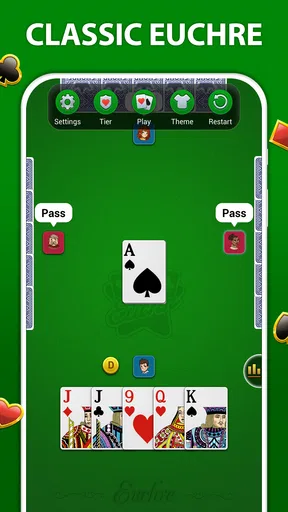
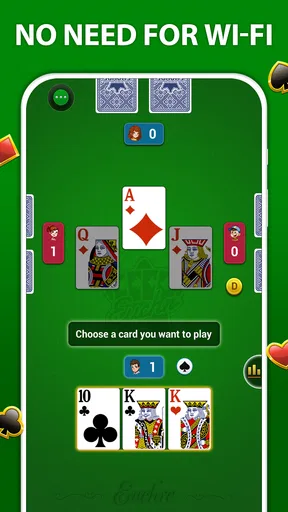
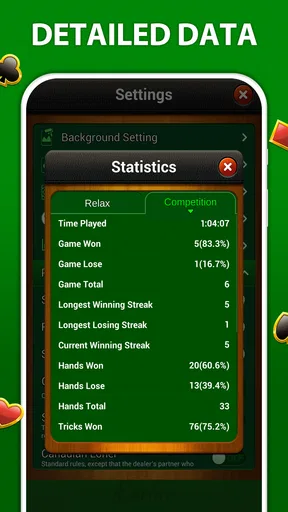


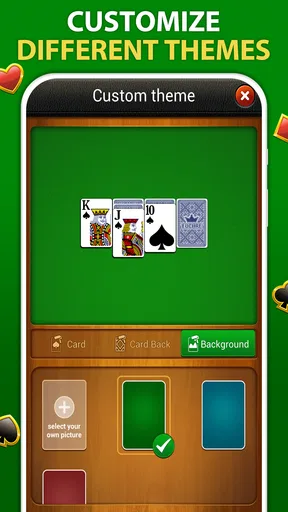
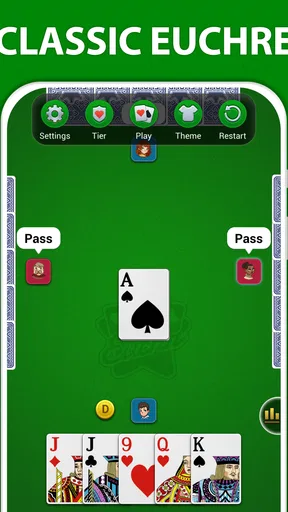
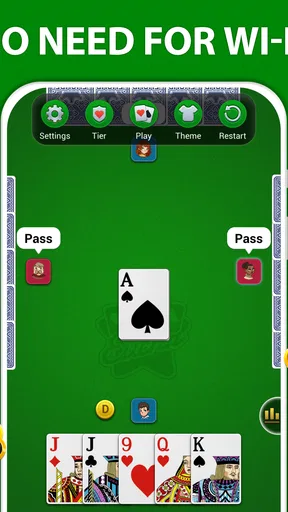
Our Review of Euchre - Card Game Offline
 Analysis by Appyee
I approached Euchre - Card Game Offline as the kind of game I could keep on my phone for short, quiet breaks rather than as a large, content-heavy pastime. That expectation matters here. This is a free card game from Topy Games, focused on Euchre and designed for playing without an internet connection. After spending time with it, I found its appeal comes from the compact nature of the game: a hand can be considered, played, and finished without needing a long session or a live opponent to be available.
Its current store presence suggests a healthy audience, with an average rating of 4.6 from roughly 50 thousand ratings and more than a million installs. Those figures do not make it automatically perfect, but they do fit my experience of a specialized card game that is easy to understand once the rules click. It is available at no upfront cost, is rated for Everyone, and runs on Android devices using version 6.0 or later. That combination makes it approachable for both newcomers and people who want a simple Euchre table in their pocket.
How the current version feels in everyday play
The first thing I noticed is that the offline focus changes the rhythm completely. I do not have to wait for a match, depend on a stable connection, or arrange a game with another person before starting. If I have a few minutes while waiting for an appointment, I can open a hand and concentrate on the decisions in front of me. If I have more time, I can continue playing without the session feeling tied to a social schedule.
That makes this a particularly practical choice for travel, commutes, and places where connectivity is unreliable. I can imagine using it on a train with intermittent reception, during a flight, or at home when I simply want something quieter than a competitive online game. The offline design is not just a technical convenience; it gives the game a self-contained feeling that suits Euchre well.
Euchre itself rewards attention more than rapid tapping. The important moments are usually deciding whether to accept the proposed trump, choosing when to call a different suit, and judging how aggressively to play a strong card. I found that the short format makes these choices feel meaningful without demanding the long concentration of a full-length strategy game. A weak decision can still teach me something, because I can quickly start another hand and test a different approach.
For a new player, the main challenge is not operating the app but understanding the logic of the card game. Euchre has its own vocabulary and conventions, especially around trump and the role of the right and left bowers. A person familiar with games such as Hearts or Spades may recognize the trick-taking foundation, but should not assume that every familiar rule carries over. I recommend learning the basic ranking and scoring before trying to play quickly; otherwise, the first few hands can feel confusing rather than strategic.
A useful routine for learning the decisions
My preferred way to use it is to treat the opening sessions as practice rather than as a test of skill. I pay attention to why a particular card wins a trick, which suit is currently trump, and what the other hands appear to be holding. Instead of trying to remember every card immediately, I first track the highest trump cards. That habit gives me a better sense of whether I should protect a winning card or spend it early to control the hand.
Another helpful approach is to pause mentally before every call. I ask myself whether my hand has enough strength in the proposed trump suit, whether my partner is likely to contribute, and whether passing would leave me in a better position later. This is more useful than simply chasing the most attractive-looking card. The game becomes much more interesting when I treat each call as a probability decision instead of a guess.
Offline card games can sometimes feel repetitive because they are built around one familiar ruleset. Here, repetition is both the strength and the limitation. I can replay hands whenever I want, which makes it good for improving pattern recognition, but anyone looking for a broad collection of card games will probably prefer a larger multi-game app. This title is more focused than versatile.
What the developer’s current release tells me
The current version is listed as 1.3.14.20260717, while the game was released on June 16, 2023. I see that as evidence of an established product rather than a brand-new experiment. The version number indicates that the app has moved beyond its initial release, but I would not treat a version label alone as proof of a particular feature, interface change, or performance improvement. What matters to me as a user is that the game remains available in a form intended for straightforward, repeatable play.
For someone already using an earlier build, the practical expectation should be continuity rather than a completely different game. The core attraction remains the same: a focused Euchre experience that can be played offline. Existing users who enjoy the current flow are unlikely to need to relearn the entire product simply because the version has advanced. At the same time, I would still check the update notes in the relevant app store before installing an update, especially if I rely on an older device or prefer not to change a familiar setup.
The stated in-app purchase price is $14.99 per item. Since the game can be installed for free, I would begin with the no-cost experience and decide for myself whether any optional purchase improves my use of it. I would not recommend paying simply because the title is popular. The right question is whether the free version already gives you the offline card sessions you wanted and whether any paid item offers a meaningful convenience for your particular habits.
That pricing detail also affects how I compare it with traditional alternatives. A physical Euchre deck costs nothing once you own cards, and playing with friends gives you the social discussion that an app cannot reproduce. On the other hand, a physical game requires other people, a table, and enough time to organize it. This app wins on availability and privacy, while a real table wins on conversation, shared reactions, and the subtle negotiation that comes from playing face to face.
Who benefits most from the offline format
I think the strongest audience is someone who already knows Euchre or is willing to learn it and wants a dependable solo option. It is also suitable for a player who dislikes online matchmaking, does not want to create an account just to play cards, or prefers not to expose a game session to network interruptions. The Everyone rating makes it easy to recommend as a family-friendly type of card entertainment, although younger players may still need an adult to explain the rules.
One realistic scenario is a person taking a long bus ride with a phone that is not guaranteed to stay connected. They can start a hand before leaving, continue through several rounds, and stop whenever they arrive without worrying about a live match being interrupted. Another is a regular Euchre player who wants to practice calling decisions between weekly gatherings. In that situation, the app works as a private rehearsal space: it cannot replace a human partner’s personality, but it can keep the rules and card-reading habits active.
I also see value for people who want a calm alternative to more demanding mobile games. There are no large maps to explore, no complicated progression system to maintain, and no need to dedicate an entire evening. I can pick it up when I want mental activity without the noise of a typical action game. The trade-off is that the experience depends almost entirely on whether I enjoy Euchre itself.
I would skip it if my main goal is a broad card collection, a strong multiplayer community, or a deeply social experience. Someone seeking classic solitaire variations, poker tables, collectible-card battles, or real-time competition should look elsewhere. Even a polished single-game app cannot satisfy those needs because its narrow focus is part of its identity.
Small decisions that make sessions better
A less obvious benefit of an offline game is that I can use it as a deliberate learning tool rather than just a distraction. After a lost hand, I try to identify the earliest decision that reduced my chances. Was the call too optimistic? Did I spend the strongest trump card before it was necessary? Did I fail to notice that a suit had already been exhausted? Reviewing one decision is more productive than blaming the final trick.
I also recommend playing in short blocks when learning. Because the game is built around compact hands, I can stop after one or two and still feel that I completed something. That is useful for people who tend to abandon mobile games when they demand a long uninterrupted session. It also prevents tired decisions, which can make a strategic card game feel unfair when the real problem is simply rushing.
For experienced players, I find the best challenge comes from changing the goal of a session. One time I may focus on recognizing when a weak hand should be passed. Another time I may concentrate on remembering which trump cards have appeared. This turns repeated play into targeted practice. It is a stronger use of the app than mindlessly tapping through hands while watching something else.
The offline nature brings one important trade-off: it is convenient, but it can make the game feel self-contained. I do not get the spontaneous banter of a real table, and I cannot assume that a solo session will provide the same unpredictability as playing against people I know. For me, that is acceptable when I want practice or a quiet break, but it would become a drawback if I wanted every match to feel socially different.
Where the experience still has limits
The biggest limitation is the narrow scope. A person who does not enjoy Euchre will not find much reason to keep the game installed, because the title does not promise a collection of unrelated activities. Even for fans, repeated solo play can eventually expose the boundaries of the format. The question is not whether the game has endless variety; it is whether the convenience of having Euchre ready at any moment outweighs that lack of breadth.
There is also a learning curve that a very casual player may underestimate. The rules are not difficult once understood, but the strategic value of a card depends on the current trump suit, the cards already played, and the likely strength of the partner and opponents. A beginner who expects a simple high-card game may feel lost during the first sessions. I would give it several hands before deciding, and I would learn the ranking carefully rather than assuming standard card order.
The free-to-install model is welcoming, but the presence of optional purchases means I would pay attention during the store installation and in the app itself. I prefer to establish whether the basic experience is sufficient before spending anything. For a game whose primary value is a focused offline pastime, a purchase should feel like a considered convenience, not a requirement for understanding the card game.
Device compatibility is reasonably broad because the minimum requirement is Android 6.0, but owners of very old phones should still judge the experience on their own hardware. A supported operating system does not guarantee that every screen size, battery condition, or device interface will feel identical. I would install it on the phone I actually plan to use and see whether the cards are comfortable to read before committing to long sessions.
What I would watch as the app continues
Because the current release is more mature than the original launch version, I would watch future updates for improvements that make repeat play more comfortable without changing the focused character of the game. Clearer rule guidance would be especially valuable for newcomers. Small interface refinements can matter in a card game, where readable suits, ranks, and turn information are more important than decorative effects.
I would also pay attention to how well the app preserves its offline identity. For me, that is the feature that separates it from many modern mobile games. If an update keeps the game quick to open and usable without a connection, it protects the main reason I would recommend it. If the experience becomes dependent on online services, it would lose much of its advantage over multiplayer alternatives.
Existing players should think of the version history as a reason to keep the app updated when convenient, while still checking whether an update changes anything in their preferred workflow. New players can approach the current build as a straightforward entry point: install it free, learn the rules patiently, and judge the game by several complete hands rather than by the first unfamiliar decision.
My final view is positive but deliberately specific. Euchre - Card Game Offline is not trying to be an all-purpose card arcade or a replacement for a lively table of friends. It is a focused way to play Euchre alone, especially when I need something that works without a connection and fits into an unpredictable schedule. I recommend it to fans of trick-taking games, travelers, learners who want private practice, and anyone who values a quiet strategic break.
I would choose a different app for broad card variety, live social play, or competitive matchmaking. But if your question is whether this is a sensible free starting point for offline Euchre on a compatible Android phone, my answer is yes. The best way to use it is to treat each hand as a small lesson: slow down at the calling decision, track the important trump cards, and accept that the game’s simplicity is both its charm and its boundary.
Verdict
Strengths of Euchre - Card Game Offline
- Playable offline, making it useful during travel or without internet access.
- Quick rounds suit short play sessions and casual gaming.
- Simple rules and controls are approachable for new players.
- Adjustable difficulty can provide a challenge as skills improve.
- Low storage needs make it practical for most Android and iOS devices.
Limitations of Euchre - Card Game Offline
- Offline opponents may feel predictable after extended play.
- Limited variety can reduce replay value for experienced players.
- Card animations may feel slow when playing many consecutive rounds.
- Some features may be restricted or supported by advertisements.
- No real opponents means less excitement than live multiplayer matches.
Other Releases by Topy Games
View All

Spelling Quiz - Word Trivia
Word4.8

Trivia Master - Word Quiz Game
Trivia4.5

Gin Rummy: Classic Card Game
Card4.9
Similar Picks in This Category
View All
Solitaire - Classic Card Games
MobilityWare4.6

UNO!™
Mattel163 Limited4.3

Spider Solitaire: Card Games
MobilityWare4.6

Solitaire.com - Classic Cards
Tripledot Studios Limited4.7

Plants vs. Zombies™ Heroes
ELECTRONIC ARTS4.1

Hearthstone
Blizzard Entertainment, Inc.4.1
Frequently Asked Questions
Can I play Euchre - Card Game Offline without an internet connection?
Yes. Euchre - Card Game Offline is designed for playing against computer-controlled opponents without requiring a constant internet connection. After installing the game and completing any initial setup, you can usually enjoy matches in airplane mode or in places with limited coverage. An internet connection may still be needed for downloading the app, receiving updates, or accessing optional online features, depending on the version installed.
Is Euchre - Card Game Offline suitable for beginners?
The game is generally accessible to newcomers because it follows the familiar trick-taking structure of Euchre, while allowing players to learn through repeated matches. Beginners should pay attention to the trump suit, the left and right bowers, and the importance of communicating with a partner through card choices. However, the exact tutorial and difficulty options can vary, so new players may need a few rounds to understand the scoring and bidding flow.
Does the game include different difficulty levels or customizable rules?
Many players will want to know whether the computer opponents can provide a serious challenge after the basics become familiar. Euchre - Card Game Offline commonly focuses on adjustable artificial-intelligence difficulty and traditional gameplay settings, although available options depend on the specific release and device. Before downloading, check the store listing for details about scoring rules, player count, difficulty modes, and any regional Euchre variations.
Is Euchre - Card Game Offline free to download, and does it contain advertisements?
The game may be available as a free download, but free versions can include advertising, optional purchases, or restrictions on certain features. Ads may appear between rounds or when navigating menus, while paid upgrades can sometimes remove advertising or unlock additional settings. Because pricing and monetization can change with updates, review the current Google Play or App Store listing before installing if an ad-free experience is important to you.
Can I play against real people or only against computer opponents?
The main appeal of an offline Euchre title is the ability to play complete matches against artificial-intelligence partners and opponents whenever you want. That makes it convenient for travel or quick practice sessions, but it does not necessarily provide live multiplayer. Some versions may offer online or local multiplayer features, while others are strictly single-player, so confirm the current feature list if playing with friends is a priority.
Play our best games!


